
Some authors tightly control their characters, requiring them to follow an outline. But other authors say there are things their characters won’t do. What do authors do when their characters go off script? Do you try to regain control (and how?) or go where the characters take you?
Continuing with my Balticon 57 panel write-ups, the panelists for the titular panel were: A. L. Kaplan, Alan Smale, and Scott Edelman, moderated by Michelle D. Sonnier.
How Do Characters Get Off Track?
The type of writer you are influences the ways your characters can get off track. Pantsers are writers who write by the seat of their pants, discovering the characters and plot as they go. Planners are the opposite, they know exactly where they’re going and how the story is going to get there. And plantsers are in between, they have a direction to go in, but know that things are going to change along the way.
- For heavy planners, characters are often used as puppets, and they go where they’re told
- For other planners and plantsers, as they write the characters and get to know them better, these writers realize the original intent won’t work for this character and have to adjust
- Some see where the story goes
- Some pause to re-outline before moving forward
- Some characters basically ‘yell’ at the author, demanding more scenes and page-time
- Sometimes, the scene fights the writer, and they just can’t get it to work — often when the scene is wrong for the character and needs to be re-thought
- For pantsers, though, there’s no track for the characters to get off of!
Do You Follow the Characters or Reel Them Back In?
So, your story’s becoming more character-driven. Now it’s time to decide, do you follow this notion or back up and make the story go the way you’d originally intended.
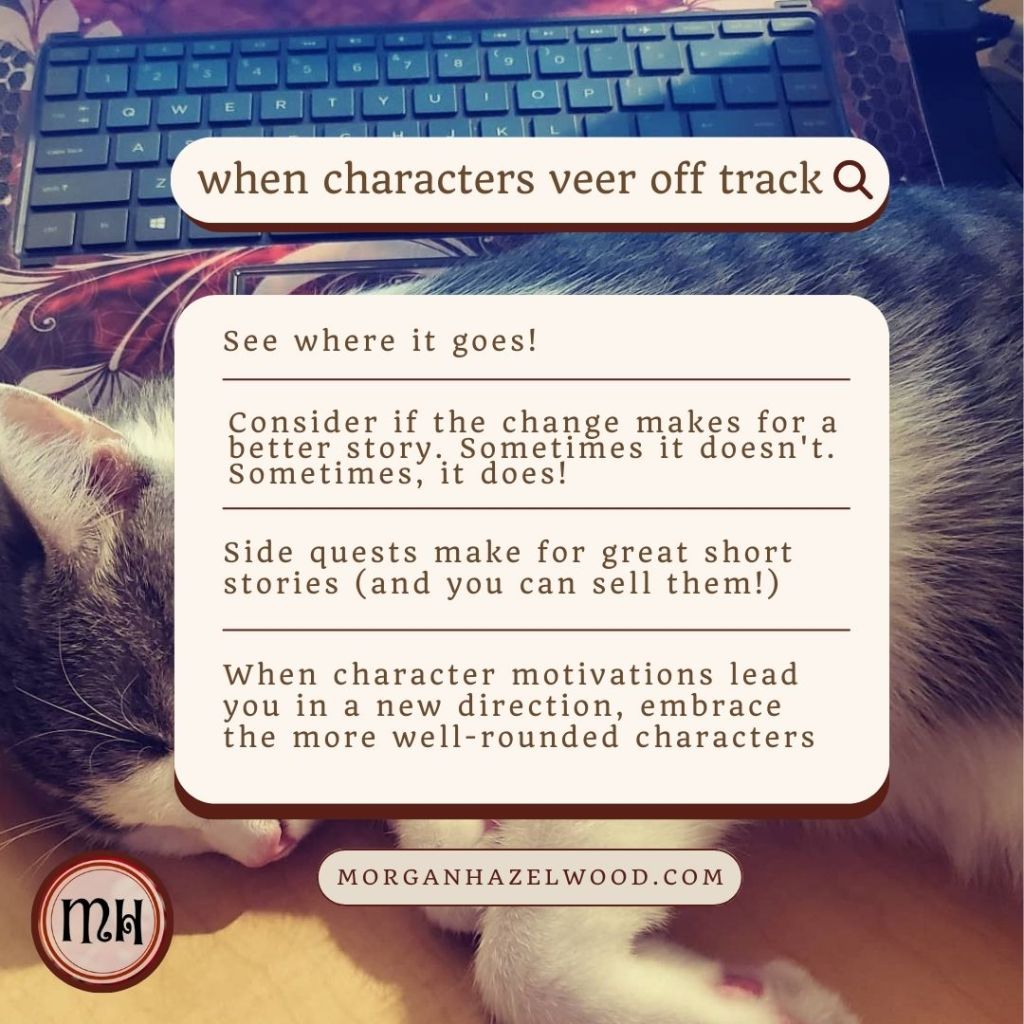
- If the story fights you when you don’t follow their lead, it might be best to see where it takes you
- Think it through, will this change make for a better story, with more well-rounded characters? If so, go with it!
- Try it out, if it doesn’t work, make it a deleted scene
- Maybe it’s a side quest that would make a good short story (you could sell it on the side!)
- Sometimes, the rails shift, but you never fully leave them. Letting better character motivations and more fleshed-out characters pull the story along is good for everyone
- Pantsers always follow the character (or the plot) and see what unfolds. For many, looking too far ahead spoils the joy of writing
Examples of Characters With Agency
Typically, it’s not that the characters are out of control, it’s that you, as a writer, better understand the nuances of the character and understand the choices they would make. This gives the characters agency, and is usually a good thing!
- For A.L. Kaplan, she had two secondary characters fall in love, and that helped demonstrate a fair amount of world-building for her story
- For Alan Smale, he had multiple characters that he thought were going to band together to accomplish a singular goal. One problem, they all had different ideas of the best way to go about it, so they often ended up working at cross-purposes, leading to a more complex storyline, with better rounded characters
- For Scott Edelman, he tried writing a short story for a ‘Glorifying Terrorism’ anthology (in protest of the UK banning works of that theme. Which could be expanded to include MacBeth among others)… but instead, his characters found a better way to get rid of the alien destroyers.
- For Michelle Sonnier, she was writing a Regency-era tale of seven sisters, one of which had no interest in debuting to Society — and Michelle realized the character was asexual. Two books later, that comes into play as the asexual sister struggles with ‘losing’ her sister and friend to marriage. It helped clarify the motivations of the characters, even books later.
It makes one wonder, are the characters out of control, or is this some manifestation of the writer’s own subconscious desires or fears?
Ways To Get To Know Your Characters Better

- Do your research — their job, background, hometown, etc
- Find experts — ask your social media friends, network online or in person, ask librarians, or professors, or check out youtube (Mary Robinette Kowal has an Interviewing Experts playlist)
- Note: if you do reach out to experts, make sure you have specific questions prepared, and not information you can find in 10 minutes on Wikipedia or with a textbook
- Let the characters percolate in the back of your head for a bit
- Write 100 random facts about your character, or fill out a questionnaire as your character — none of this needs to be in the story, it’s just so you can know them better
- Find some aspect you can connect with — even if they’re the cruelest villain, maybe you share a fear or a hope
If you’re a writer, have you ever struggled with characters not going the way you had expected or intended them to go? How did it turn out?


I’ve never quite been comfortable with “pantser”, because to me, I write when the story tells me to sit down and type while it dictates – that’s more the whole story telling me what to write.
Sometimes, however – and it may be that I’m the one seeing something wrong – I’ll start a section, and it just stops. Trying to write further doesn’t happen. This has happened twice, majorly… and both times, I finally realized “that would be mil-sf, and I don’t write mil-sf”. Went back to where the change came, and tried suggesting something else to the story, and the story went “yep!”, and away it went.
LikeLiked by 1 person
Just don’t let your personal distaste of Military sf stop you from doing what’s right for your characters.
And I still maintain it’s better to tell people what you DO write, rather than disparaging a similar genre with a large cross over audience.
LikeLike
You misunderstood what I was saying. I don’t write mil-sf, and my stories don’t write that way. That’s why I was hung for days.
What I’m saying is that anyone writing the way I do, if they find themselves hung, might look at the last turning in the story, and consider if that’s the way it really needs to go, or if they turn it differently, it will work.
LikeLiked by 1 person
And pantsers are also known as discovery writers. Perhaps that will fit you better? You find out what happens as you go along, whether it’s your creativity or “listening” to your characters.
LikeLike