
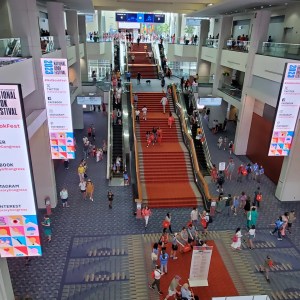
Earlier this month, I made it out to the Library of Congress’s 23rd annual National Book Festival. It was hosted inside the Walter E. Washington Convention Center (instead of outside on the lawn that is the Capital Mall like it was for the first 14 years).
It’s been a while since I’ve been to a book festival, and never one of this scale. There were definitely a lot of differences between this and the fan-run science-fiction, fantasy, and horror conventions I usually hit up.
Book Festivals versus Cons
1. Cost
It was free. Most fan-run conventions are labors of love and funded primarily by attendees, but this one has huge sponsors and is run by the Library of Congress itself.
2. Panels
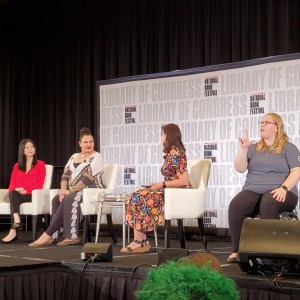
The book festival’s panels paired up two authors with similar themes, hosted by an interviewer (many from NPR – National Public Radio) asked them to talk about their books, perhaps read a segment, and then a few questions about the matched theme before opening to audience questions. They really showcased the authors and their featured book.
The biggest names were solo authors, interviewed the same way.
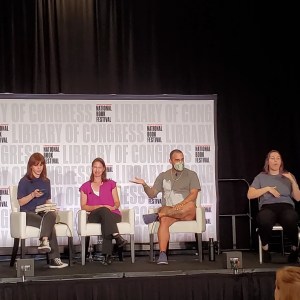
At the fan-run cons I usually attend, the moderator is either another author, or a member of the staff, and the discussion focuses on the subject of the panel. Using your own book as an example, more than once, (unless you’re the guest of honor), is usually frowned upon. Sure, we all know you’re there to promote your work, but focusing on your own books is usually reserved for book readings or ‘kaffeeklatches’ — or coffee hours, where you sit down with a small group of fans and answer questions.
3. The vendors

The book festival featured a booth for every state in America, letting them showcase a handful of books by their own local authors, several booths from large traditional booksellers (including Schoolastic with a Clifford the Big Red Dog photo op), and the host bookstore, which had the books for the states, the featured book for the panel authors, and some featured swag.
At fan-run conventions, there are usually booksellers featuring books across the genre, small publishers, and authors — both traditional and indie — selling their own books. And that’s not even talking about the artisans and such selling items that aren’t books.
4. Concurrent events

The book festival had 6 stages and a lounge for book signings. They were oddly staggered at different intervals, so it made it a little challenging to attend items from time-slot to time-slot.
At fan-run conventions, I’ve seen 6 panel rooms — at a small, local college convention. Most conventions I’ve attended, even the ones “only” in the 1,000 attendee range, tend to have 8, or 12, or more panels at the same time, so you can always find something to do. And while several have played with timing, they generally all start at the same time, or are empty for half a time-slot, to re-align with the other events.
5. The Hours
The National Book Festival was a single-day event, with doors opening at 8:30am and closing at 7pm. Yes, there was a kick-off the night before, and a virtual panel-a-day in the run-up to the event, but the actual in-person event was one day.
Most fan-run conventions are multi-day events: two, to three, to week long events!
What do they have in common? Amazing guests
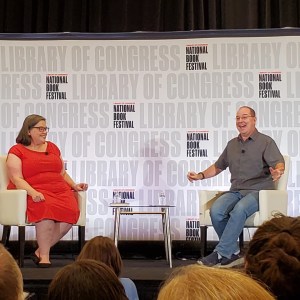
Both the book festival and the fan-run conventions I typically attend had amazing guests. After hearing about their books, my ridiculous to-read pile just got that much longer.
The National Book Festival has the clout for a lot of big name authors and interviewers. Some fan-run conventions, like DragonCon, draw a lot of big names, other fan-run conventions, only the Guest of Honor will be a big name.
But, big name or not, the panelists and speakers at both make for excellent events!
Have you made it out to any book festivals, fan-run conventions, or other events?
What differences did you see?

 WRITING TIPS & WRITERLY MUSINGS
1 Comment
Comments are closed.